Posts

11: Einsatzgruppen

Image
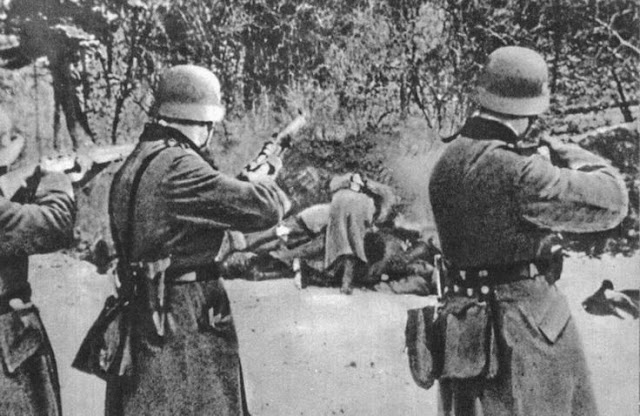
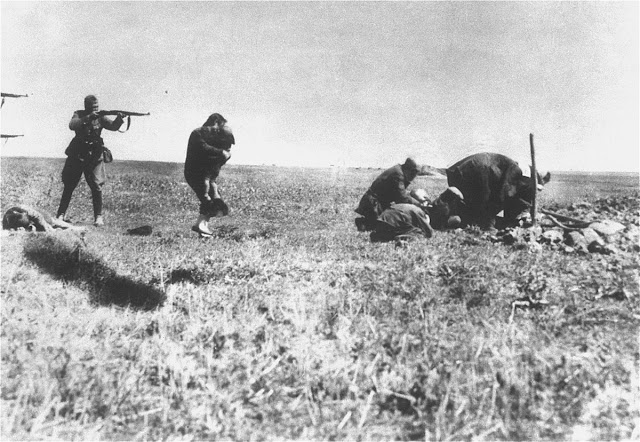
Four SS Einsatzgruppen, of 3,000 men each, followed in the wake of the German armies that invaded the Soviet Union. Their mission was to insure the security of the operational zone; that is, to prevent resistance by civilians. These were police of a very special nature, given an additional task by their chief, Reinhard Heydrich. They were to round up and liquidate not only Bolshevik leaders but all Jews, as well as gypsies, "Asiatic inferiors" and "useless eaters," such as the deranged and incurably sick. To supervise this mass killing, Heydrich and Himmler had been inspired to select officers who, for the most part, were professional men. They included a Protestant pastor, a physician, a professional opera singer and numerous lawyers. The majority were intellectuals in their early thirties and it might be supposed such men were unsuited for this work. On the contrary, they brought to the brutal task their considerable skills and training and became, despite qualms,...
10: Hitler Moves East

Image
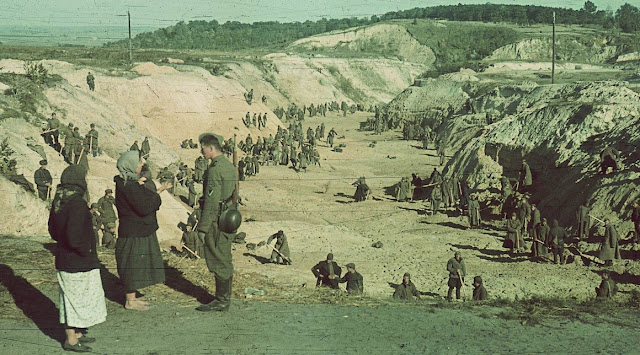
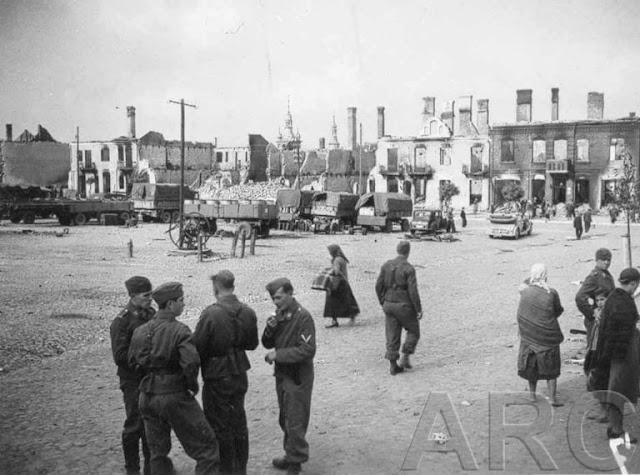
With the German invasion of the Soviet Union on June 22, 1941, the mass murder of Jews began within a few days, on a scale hitherto unknown. Before June 1941, the Jews under Nazi rule had been subjected to persecution, humiliation, expulsion and random killing. In June 1941, began the deliberate attempt to destroy all Jewish lives over a vast region of Europe. In the immediate wake of the victorious German Army  came the  Einsatzgruppen . Within twelve months, more than one million Jews had been murdered east of the September 1939 border of Greater Germany. Most were driven from their homes, forced at gunpoint to pits and ravines a few miles away, ordered to undress and then shot. No mercy was shown. The Germans understood the complex make-up of the regions through which they advanced. They knew of and exploited the historic tensions between Christianity and Judaism, and between the local people and the Jews. As a result, they were able to call on Lithuanian, Latvian, Beloruss...

9: "Ghettos"

Image
At a top secret meeting in Berlin on September 21, 1939, Reinhard Heydrich told the commanders of several SS operational groups in Poland that his "ultimate aim" for Polish Jews must be kept "strictly secret." Meanwhile, he wanted large areas of western Poland to be "cleared completely of Jews," and elsewhere the Jews were to be confined in special areas of cities and towns. Any Jews living outside the designated area would be forced to move into the confined area, which was to be called a "ghetto." Ghettos had existed, as Jewish quarters of towns, hundreds of years earlier, but unlike there medieval predecessors, the new ghettos were to be surrounded by barbed wire, brick walls and armed guards. The ghettos were to be located in cities on railway junctions or along the railway, "so that future measures may be accomplished more easily." The first ghetto was set up in Piotrkow on October 28, 1939. Jews living throughout the town were for...

8: War!

Image
From September 1, 1939, the Polish Army fought bravely against far larger and better armed German forces attacking them from the north, west and south. A few weeks after the German invasion the Soviet Union, as part of a secret pact signed a week before the German attack, entered Poland from the east. On September 17, Stalin's forces advanced to an agreed line that cut Poland in half. Ten days later, after a tenacious defense against surrounding German forces, Warsaw surrendered. The Nazi-Soviet partition of Poland left more than a million Polish Jews on the Soviet side of the partition line. They were joined by a quarter of a million Jews who managed to cross the new border from west to east before it was sealed -- or who were deliberately pushed over the border by the Germans. The Jews who found themselves under Soviet Communist rule were fortunate for the most part. Most of them survived the war, having been sent by Stalin to Soviet Central Asia, or to labor camps in Siberia. Wh...

7: The Horror of Total War

Image
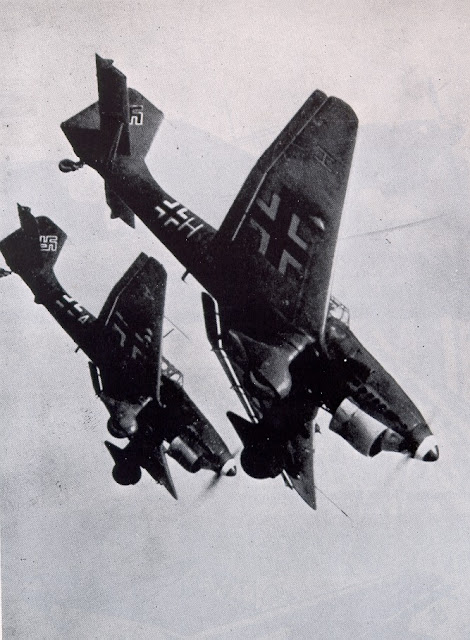
The German Blitzkrieg into Poland in September 1939 involved three elements of air power. First, air attacks destroyed much of the Polish air force while it was still on the ground. Second, bombers hit road and rail communications, assembly areas and munitions dumps. Third, fighters and dive bombers attacked columns of Polish troops as well civilian refugees. On September 2, the Luftwaffe conducted air raids on Warsaw, Gydinia and many other towns. In Warsaw a hospital for Jewish children was bombed. The railway station in Kolo was hit and 111 people were killed, many of them refugees from border towns. Adolf Hitler's aim in Poland was more than just the conquering of territory, he also sought to impose German rule on Poland. To achieve the latter aim, three regiments of SS Death's Head troops were to follow the army's advance and conduct "police and security" operations. The SS were ordered to "incarcerate or annihilate" every enemy of Nazism. Whole vil...

6: Galen Opposes T-4 Action

Image
Clemens Augustinus Emmanuel Joseph Pius Anthonius Hubertus Marie Graf von Galen (16 March 1878 – 22 March 1946), better known as Clemens August Graf von Galen, was a German count, Bishop of Münster, and cardinal of the Catholic Church. During World War II, Galen led Catholic protests against Nazi euthanasia and denounced Gestapo lawlessness and the persecution of the Church in Nazi Germany. He was appointed a cardinal by Pope Pius XII in 1946, shortly before his death. After serving in Berlin parishes from 1906 to 1929, he became the pastor of Münster's St. Lamberti Church, where he was noted for his political conservatism before being appointed Bishop of Münster in 1933. Galen began to criticize Hitler's movement in 1934. He condemned the Nazi "worship of race" in a pastoral letter on 29 January 1934, and assumed responsibility for the publication of a collection of essays which fiercely criticized Nazi ideologist Alfred Rosenberg and defended the teachings of the Ca...

5: The T-4 Program

Image
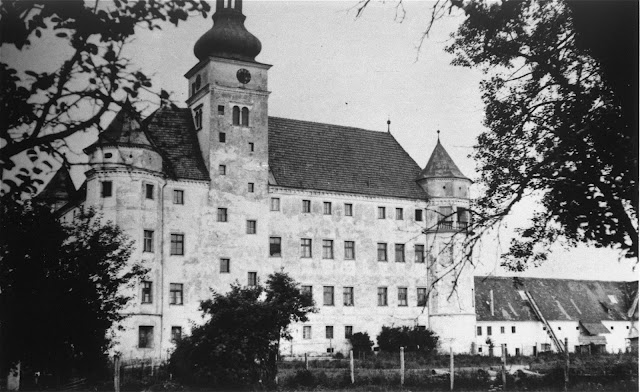
The wartime atmosphere fostered new programs that would make large a contribution to the technology of the Final Solution. A number of these involved the quiet killing of mental patients and deformed children -- "useless eaters," in the Nazi vernacular -- usually with poison gas and lethal injections. The Fuhrer had personally taken the lead in this program in 1938 when he received a request from the father of a deformed child asking that the child be put to death. Hitler wrote a letter to the parents concurring in their request for the action. He asked his personal physician, Karl Brandt, to attend to the matter. In early 1939, the government established the Reich Committee for Scientific Research of Hereditary and Severe Constitutional Diseases. Its function was to organize the killing of deformed and retarded children. Committee experts asked doctors, midwives and hospital administrators to notify them of eligible children. Then the committee established special children...